

Project Overview
Strategy
Brand Strategy, UX Strategy
Design
UI/UX Design, Art Direction
Client
Confidential
Problem Statement
- Increased average handling time (AHT) for retail store associates.
- Frustration for both customers and employees due to prolonged service times and navigation errors.
- Higher training costs and a steeper learning curve for new store personnel.
The Solution


I play a role of
Design Strategy
Problem Solution
Insights & Analytics
User Research
User Persona
Information Architecture
Empathy Mapping
Usability Testing
User Flow
Wireframe
Prototyping
Deep Understanding the Users and the Industry
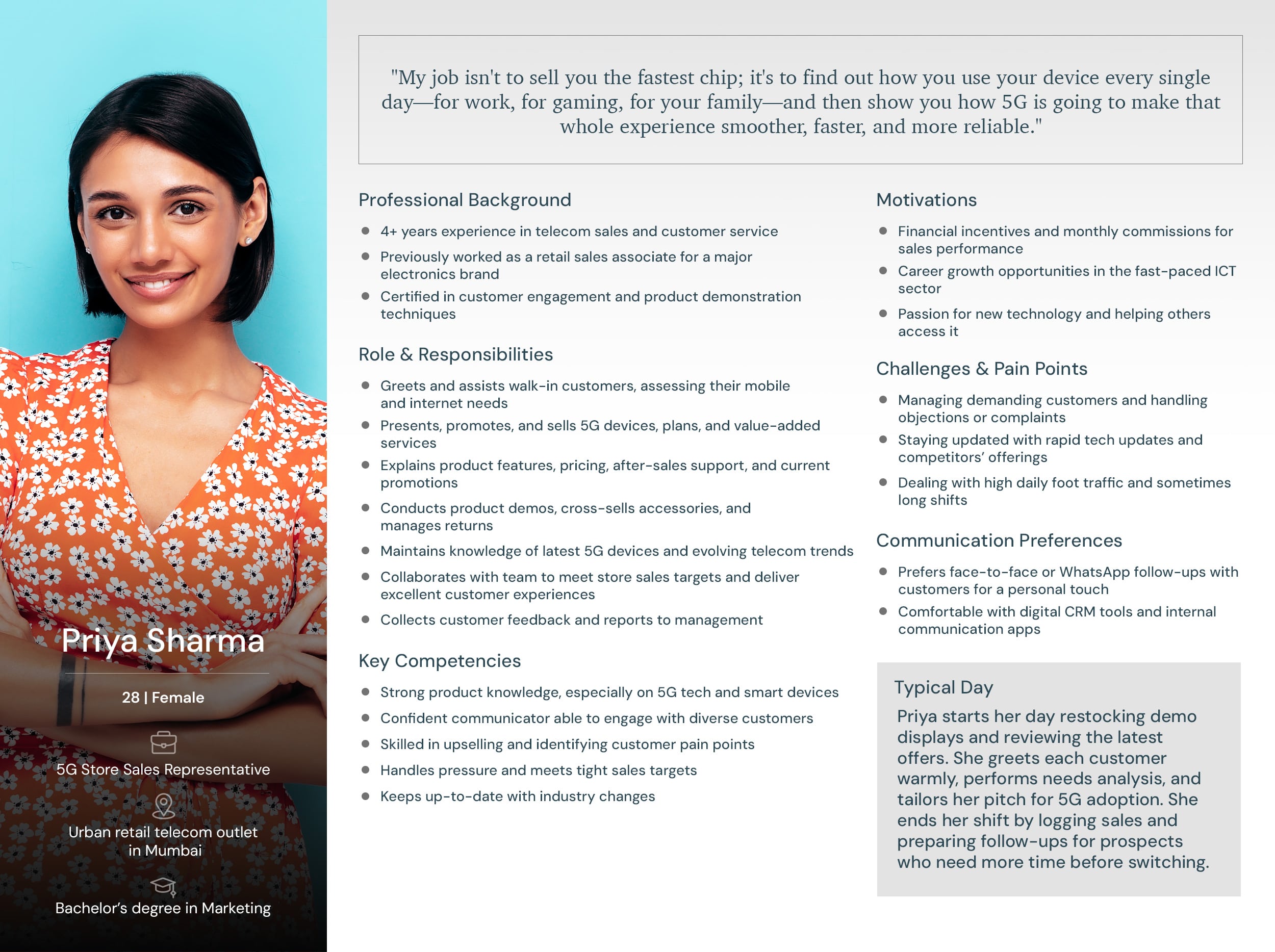
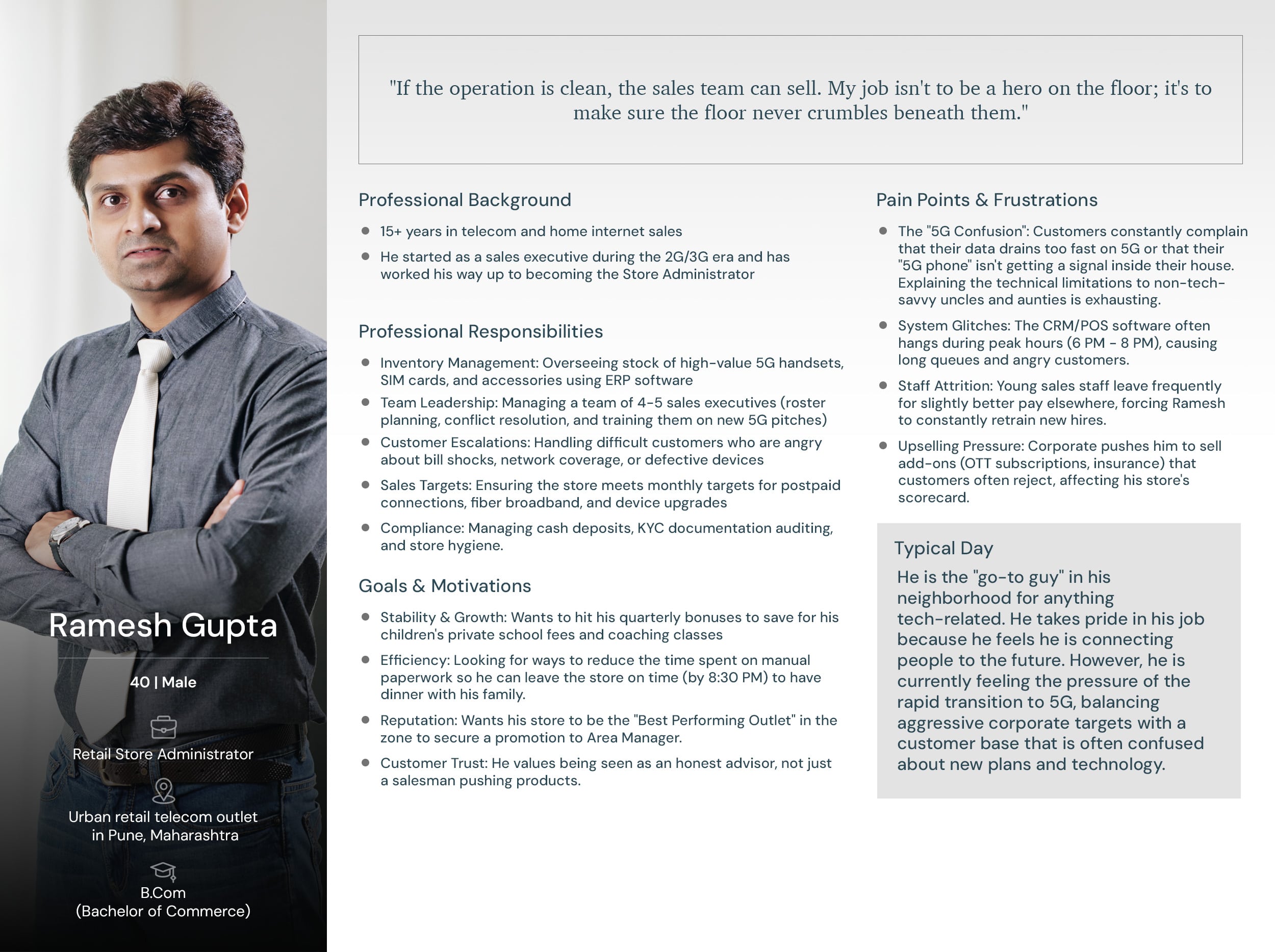
During the initial week of the project, I conducted in-depth user research by visiting company retail locations. I interviewed a store manager and subsequently met with store sales representatives who are the primary users of the iPad web application.
This research provided a deep understanding of the application’s current challenges in supporting customers and the time involved in support workflows, particularly concerning the merged support modules.
I also gathered external perspectives by interviewing friends about their own customer service interactions.
Key Findings
The interviews confirmed the core functions of the application: customer support checks, onboarding, bill pay, service/number additions, new mobile sales, in-store pickup, product exchanges, and new home internet setup.
The most critical insight identified was two-fold: excessive application loading times and a complex information architecture that made key options difficult for sales representatives to locate quickly.
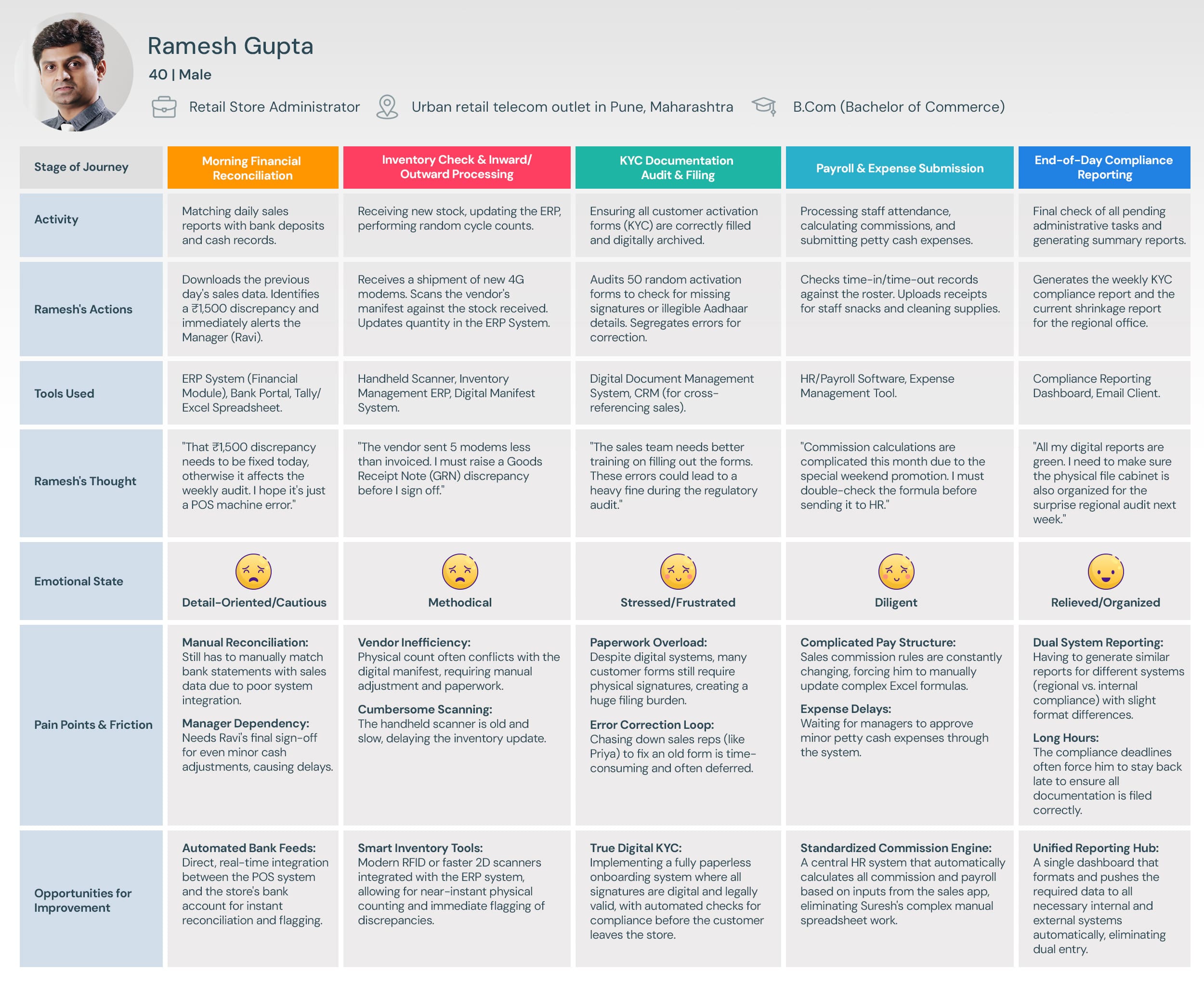
Personas & User Journey Maps
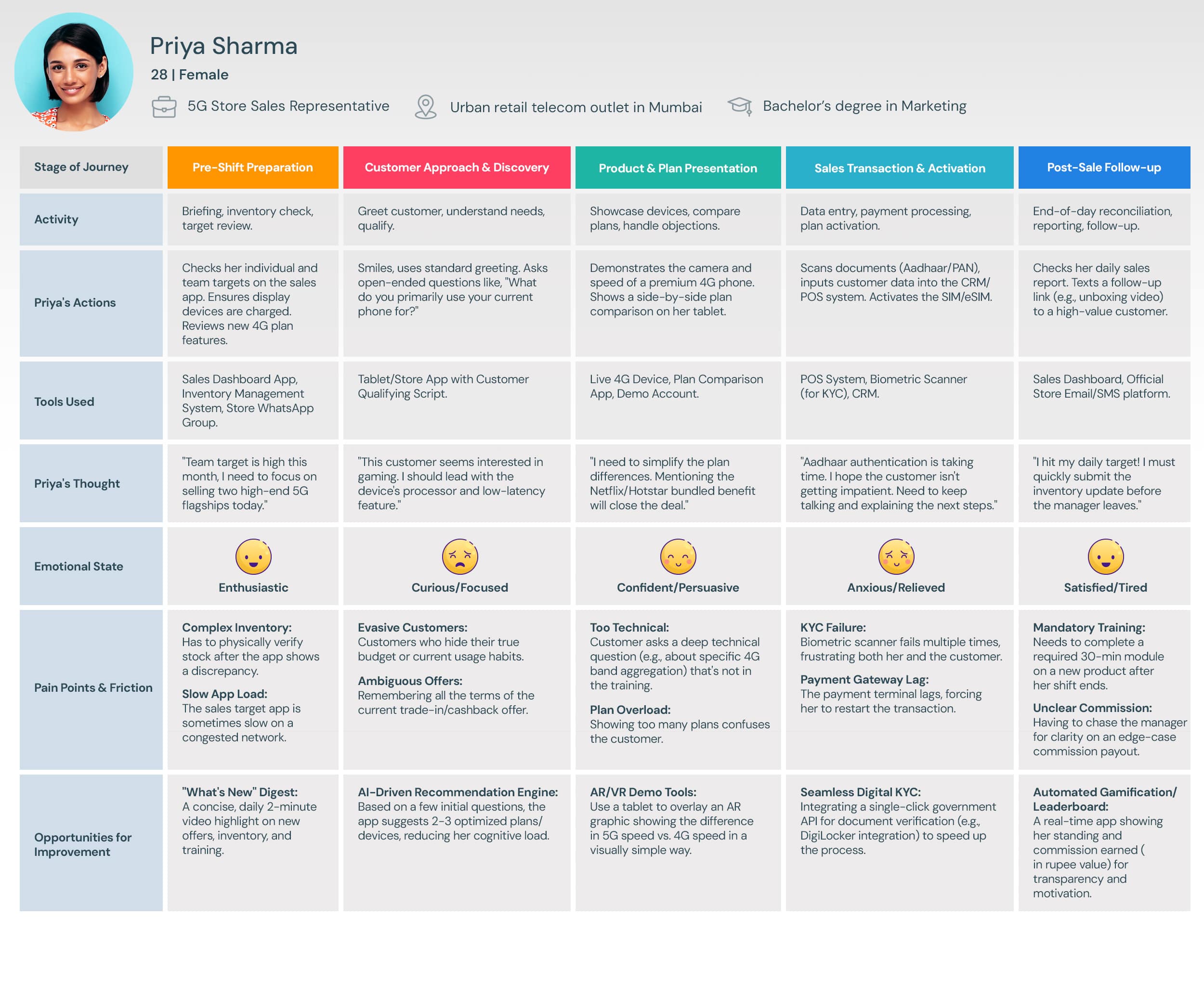
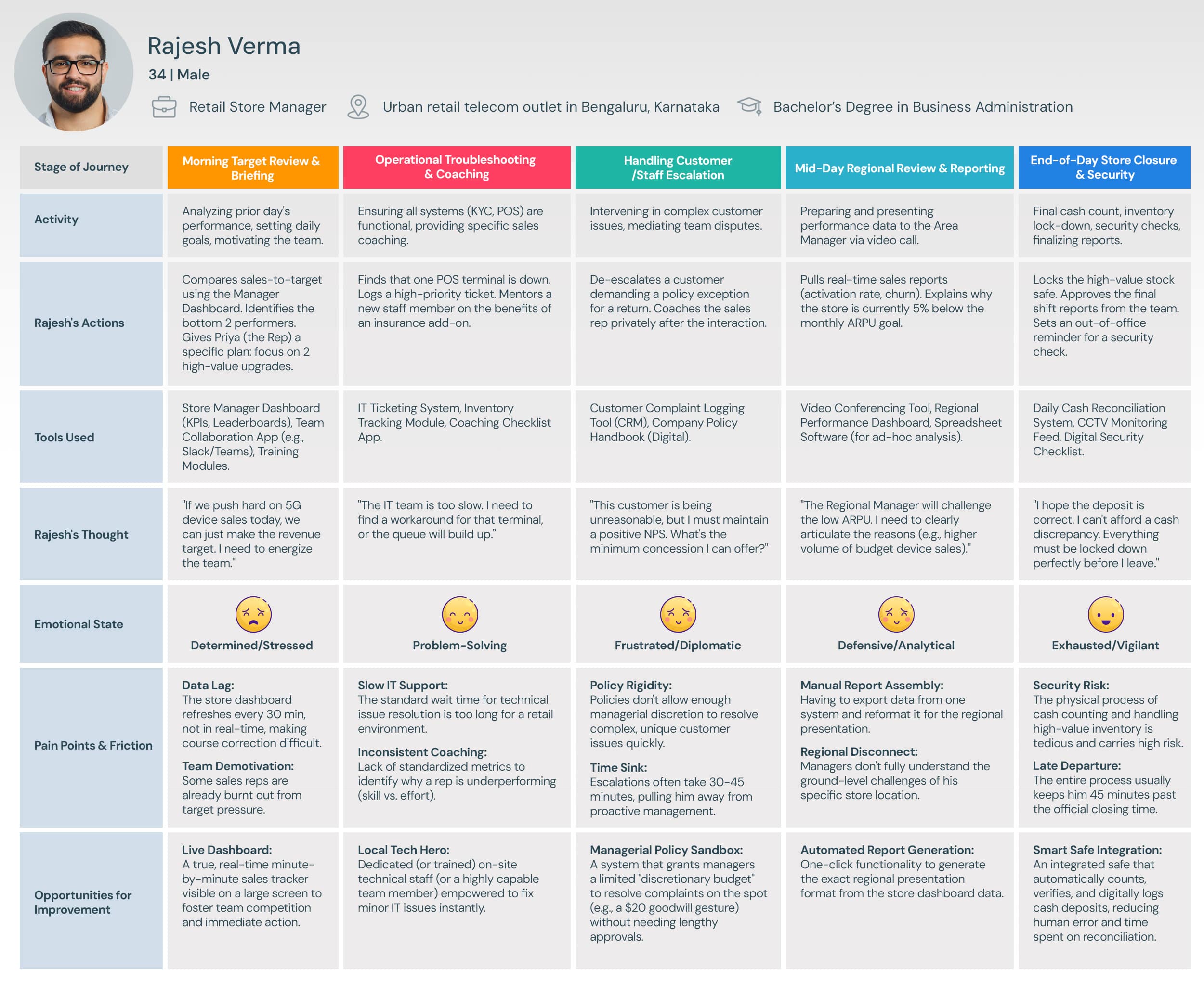
My interviews with the store manager and sales representative provided critical, detailed information. This foundation allowed me to successfully create the resulting personas and journey maps.

Information Architecture
Information Architecture (IA) is rarely a “one size fits all” discipline. Even within the same software ecosystem, different users approach the system with vastly different mental models, goals, and time constraints.
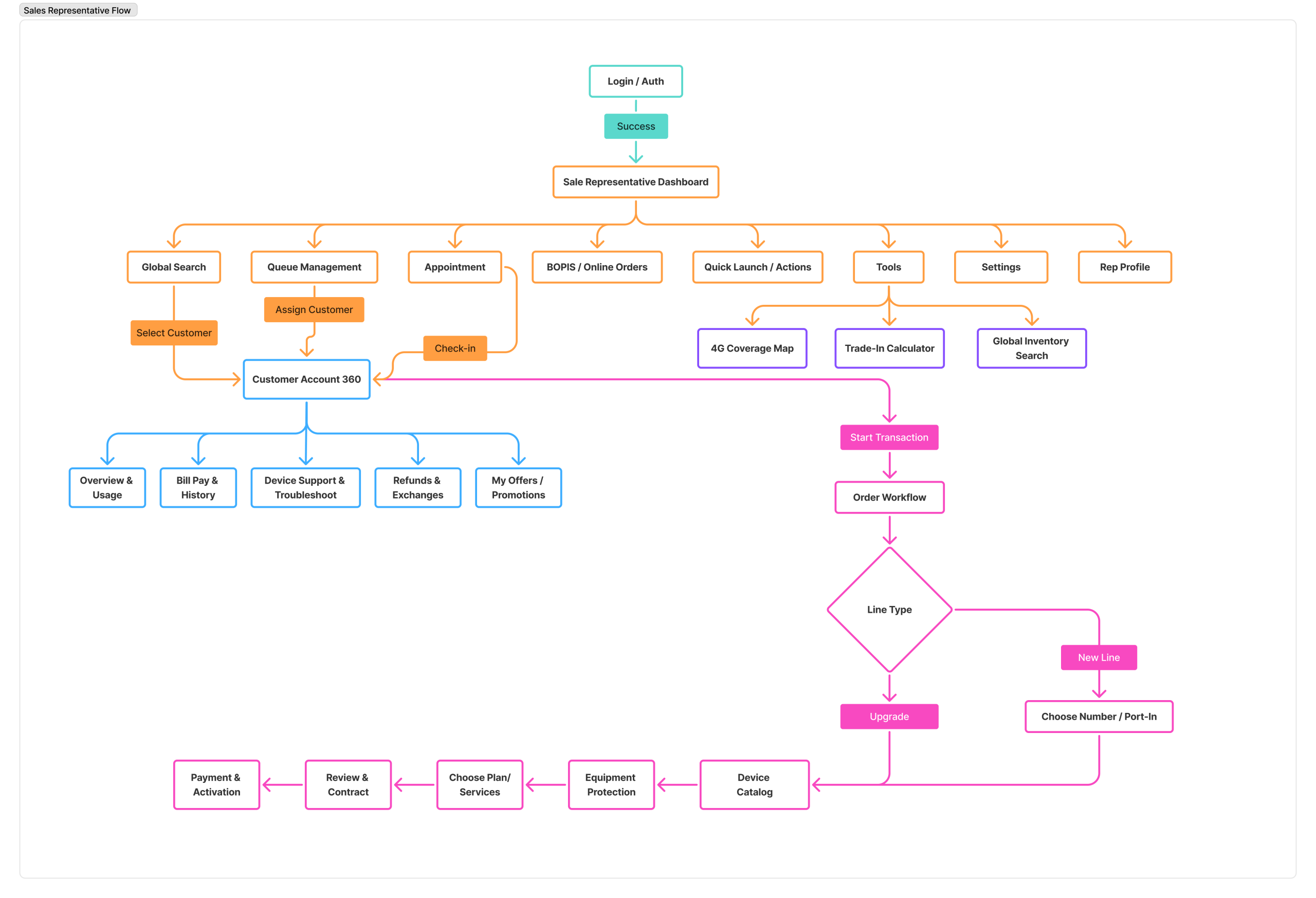
To illustrate this, let’s look at two distinct workflows for a retail application: the Sales Representative and the Store Manager. By analyzing the sitemaps and user flows for these two personas, we can see how IA must shift to accommodate specific user needs.
1. The Sales Representative: The “Tunnel” Architecture
The Sales Representative’s primary goal is efficiency and conversion. Their IA is designed to reduce friction and guide the user through a linear process.
The Hub-and-Spoke Model
Looking at the Sales Representative Flow, the architecture begins with a Dashboard acting as a central hub. However, unlike a managerial dashboard designed for monitoring, this dashboard is designed for action initiation.
- Quick Launch & Tools: The presence of
Quick LaunchandTools(like the Trade-In Calculator) indicates an IA prioritized for speed. The user needs immediate access to utility features without digging through menus. - Customer Account 360: This is the critical anchor point. The IA consolidates
Overview,Bill Pay, andTroubleshootingunder one parent node. This prevents the rep from hopping between disparate sections of the app to answer a single customer question.
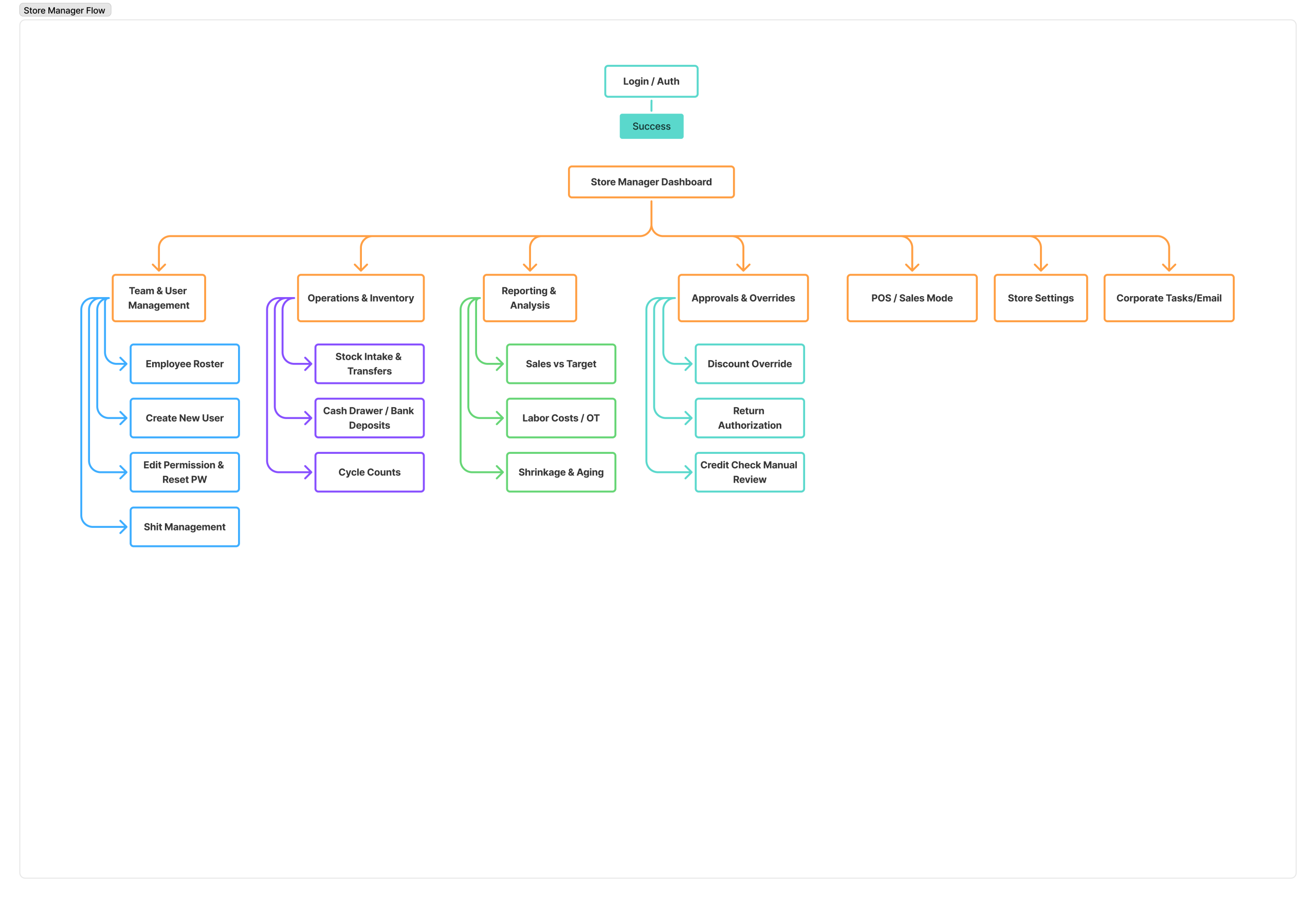
2. The Store Manager: The “Broad and Shallow” Architecture
The Store Manager’s primary goal is oversight and administration. Their flow is less about completing a single linear task and more about managing multiple concurrent buckets of information.
Categorical Grouping
The Store Manager Flow utilizes a broad, shallow hierarchy. Notice that there are no deep, multi-step tunnels like the Sales flow. Instead, the IA is organized into distinct administrative silos:
- Team & User Management: (Rosters, Permissions)
- Operations & Inventory: (Stock, Cash Drawer)
- Reporting & Analysis: (Sales vs Targets, Labor Costs)
- Approvals & Overrides: (Discounts, Returns)
Why this works: This structure supports “Berry-picking” behavior. Managers often need to jump in, approve a discount, check a labor report, and jump out. They need high-level visibility across many categories rather than a deep dive into one specific transaction.
Sales Representative Flow
Store Manager Flow
Agile way of working
The “Agile” Phase: A Retrospective Before diving into the final design artifacts, it is important to address the project’s rocky start. Early on, we fell into the trap of “Agile in name only.” While we adopted the rituals—stand-ups, sprints, and post-its—we lacked a dedicated Scrum Master to enforce the actual principles.
We found ourselves squeezed between the iterative nature of Agile and the rigid constraints of fixed scopes and tight deadlines. Internally, we joked that the process was “Agile”—neither truly iterative nor structured Waterfall. This chaotic beginning highlighted a critical lesson: process compromises often lead to product compromises.